
Franklin County Warrant Checks
Franklin County publishes no official warrant search form, so start with the Sheriff's published contact page and call 706-384-2525. Ask three things. Can staff confirm a county warrant by phone, must you appear in person, and does the answer cover only what the Sheriff holds? A traffic ticket or ordinance matter may sit with Probate, Magistrate, Superior, or a municipal court instead. Deputies serve the process. The issuing court keeps the file and the recall instructions, so a Sheriff answer is never the whole story. Georgia's own warrant guidance says to have a first name, last name, date of birth, and county ready. A case number, citation number, or issuing city heads off common-name mixups. Ask what identification is required before you hand over personal data. One caution matters here: showing up in person with an active warrant can lead to custody. For a felony allegation, a disputed identity, or an unclear surrender process, a Georgia criminal-defense lawyer can call the right office and lay out the lawful next step in Franklin County.
- Identify whether the matter began with an arrest, criminal complaint, county ticket, or city citation.
- Call the Sheriff at its published number with the minimum identifying details.
- Contact the issuing court separately and ask for current case-status and recall instructions.
- Use a narrow records request when releasable records, rather than immediate status, are needed.
- Get legal advice before an appearance or surrender when arrest is possible.
No Franklin County Warrant Portal
Franklin County posts no searchable warrant roster. No most-wanted page exists, no public warrant form, and the Detention Center site offers no warrant lookup either. GCIC, the state network that ties criminal-justice agencies to wanted-person data, allows no public self-search. A warrant may also sit with a court, a city, or a restricted file, so a thin web result settles nothing. Start with the Sheriff's direct contact, then the clerk of the court that issued the warrant. For a formal record, the Sheriff's Open Records page is the official route. When an office answers, ask which office and jurisdiction were checked, and whether that answer reflects a current status or only an old file.
Franklin County Warrant Types
Franklin County paperwork leans on a handful of terms. You will see arrest warrant, bench warrant, search warrant, and failure to appear. A bench warrant usually follows a missed court date or a disobeyed order. A search warrant authorizes a defined evidence search, not a check on your own status. Franklin Probate's traffic instructions call the order after a missed required appearance a Bench Warrant. The Texas phrase "capias pro fine" does not appear here.
| Warrant Type | How It Arises | Who Issues It |
|---|---|---|
| Arrest warrant | Probable-cause finding or another lawful basis for custody | Magistrate or another authorized judge |
| Bench warrant | Missed appearance, failure to comply, or contempt | The judge handling the case |
| Search warrant | Authority to search a described place, person, vehicle, or property | Magistrate or authorized court |
| Traffic FTA | A required county or city traffic appearance was missed | Probate or municipal court |
Franklin County Court Routing
No single Franklin County desk answers every warrant question. Magistrate Court, at 7085 Highway 145, Suite B, takes warrant applications, bail, preliminary matters, limited misdemeanors, and county ordinance cases. Its number is 706-384-7473. Probate Court sits in Suite A of the same Justice Center and handles county traffic and certain misdemeanors at 706-384-2403. Both keep weekday hours of 8:00 a.m. to 4:30 p.m. Superior Court criminal filings live with the Franklin County Clerk of Superior and Juvenile Courts, 9592 Lavonia Road, 706-384-2514. Clerk staff cannot give legal advice, and juvenile records stay restricted. City tickets and ordinance cases belong with the right municipal clerk. Find the issuing court before you call, and nobody gets treated as interchangeable.
Franklin County Warrant Records: What They Show
Franklin County publishes no sample warrant and no field key, so expect no fixed display. A record the office can release may name the subject, the warrant or case number, the issuing court, the alleged offense, the issue date, the status, and bond information. Some fields can be withheld or redacted. Read each value against the office that produced it. "Served" means the warrant was executed. "Recalled" generally means the court withdrew it. Neither word should be guessed from a payment screen or an old docket.
| Warrant or case number | The local identifier; no public Franklin format has been documented. |
|---|---|
| Subject name | Identity field that must be checked against date of birth or other approved data. |
| Charge or offense | The allegation or court matter, not a finding of guilt. |
| Issuing court | The office that controls appearance, bond, and recall instructions. |
| Bond | Security terms, if the current court record authorizes release. |
| Status | May read active, served, recalled, dismissed, or cleared; confirm the local meaning. |
Franklin Warrant Status Can Change
Warrant data shifts. Service, a court appearance, a transfer, a payment, a bond action, or a recall can each change the status. Franklin County publishes no refresh schedule and no status-code table. Pin any verbal answer to the date, agency, and jurisdiction you checked. Ask whether the office is reporting a current active entry or just locating an old record. A county answer may still miss a municipal, federal, other-county, sealed, or juvenile matter.
Quick check: Absence from a county page or city payment portal does not prove that no warrant exists.
Franklin County Warrants: Who Issues, Who Serves
Judges and magistrates issue warrants within their own authority. Franklin County Magistrate Court expressly lists warrant issuance among its duties. Superior Court takes the broader criminal matters, Probate Court holds traffic and limited criminal functions, and municipal courts handle local traffic and ordinance cases. Serving the paper falls to the Sheriff's Office and city police in their own areas. Countywide planning material names the Sheriff as Carnesville's law-enforcement agency. Canon, Franklin Springs, Lavonia, and Royston each field their own city police.
Franklin County Sheriff's Office
1 James Little Street
Carnesville, GA 30521
706-384-2525
Franklin County Records Requests
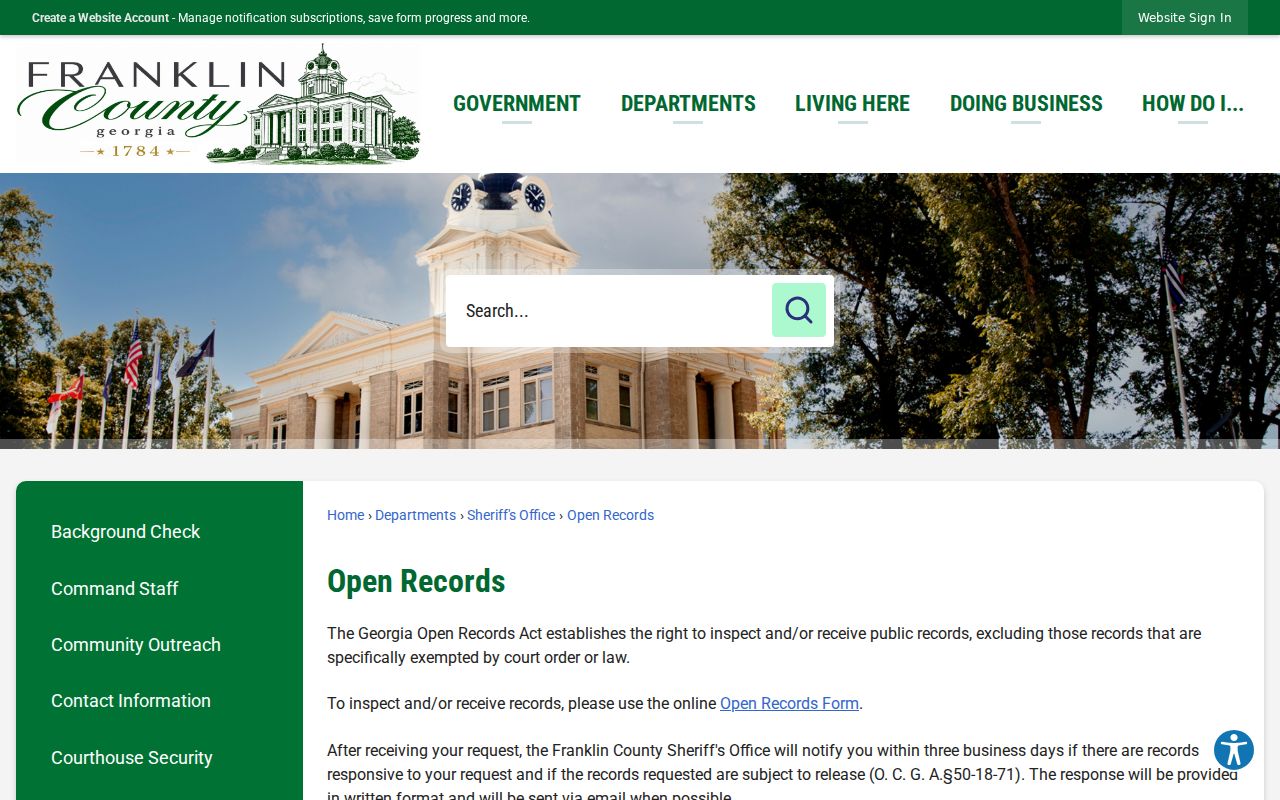
The formal route for Franklin County records runs through Records Supervisor Marcus Greer. Use the online form, email mgreer@franklincosheriff.net, call 706-384-2525, or mail P.O. Box 310, Carnesville, GA 30521. A request sent to another employee is not filed until the custodian receives it. The Sheriff answers within three business days on whether responsive records exist and whether they are releasable. That notice is not a promise that production finishes inside three days. Budget for fees. Your first 15 minutes are free. Search and retrieval beyond that may be billed at the rate of the lowest-paid qualified employee. Black-and-white letter or legal copies cost $0.10 per page. Trim early. Narrow the request by date, record type, and preferred electronic format. Request a fee estimate up front. Also ask for any segregable non-exempt portions. Judicial records follow court access procedures, so a Franklin County Sheriff request cannot compel a court to release sealed or juvenile material. The official instructions spell out the response and fee terms.
Handling a Franklin County Warrant
Start with the right court. Get the current case or warrant number, then ask the clerk which appearance, surrender, payment, bond, or motion procedure applies. Recall means a court action withdrawing an outstanding order. Only the issuing court can give reliable recall instructions. The Franklin County Sheriff can explain booking or detention procedure, but cannot stand in for the judge. Paying an eligible ticket, posting bond, license reinstatement, and warrant recall are distinct actions. One step rarely does another's work. Keep proof of every step. Save any receipt, release, recall order, or clerk confirmation the court provides. Someone who disputes identity, expects arrest, or faces a serious charge should talk with a Georgia lawyer before appearing. Franklin Magistrate rules recognize cash, qualifying property, recognizance, and professional bail bonds. The court may still set conditions and control the acceptable form. Franklin County publishes no amnesty or special warrant-clearing program.
Important: Use a published court or Sheriff number and get legal advice before a surrender when custody is possible.
Franklin Traffic FTA Path
Franklin Probate Court gives Franklin County its clearest failure-to-appear sequence. Start there. Posting cash bond on a must-appear citation does not excuse the court date. Skip it and the likely results are a bench warrant, license suspension, and a bond-execution hearing. Some citations allow a pre-court payment under the court's instructions. Must-appear offenses still require an appearance. So does a reduced-charge request, which means speaking with the prosecutor. DDS runs on its own clock. An FTA suspension takes effect 28 calendar days after DDS receives the court's notice. Fix the citation with the court first. Confirm the court sent an electronic release. Then verify your DDS status. Reinstating a license does not cancel a warrant, and a payment receipt does not prove recall. City cases belong to the municipal court. Franklin County traffic cases go to Probate Court at 706-384-2403.
Warrant Record Access Under Georgia Law
Georgia's Open Records Act leans toward inspection and copying of public agency records unless an exemption applies. Law-enforcement files can hold protected investigative material, confidential-source details, victim data, or personal identifiers. Juvenile and sealed court files face separate limits. Exemptions do exist. A Franklin County judicial record may still be viewable even when the judicial office sits outside the county's ordinary executive-branch request channel. Ask the actual custodian. Request the releasable portion and the specific exemption behind any withholding.
Key Rules:
O.C.G.A. § 50-18-70 states Georgia's public-record access policy.
O.C.G.A. § 50-18-71 governs requests, responses, and exemption notices.
O.C.G.A. § 50-18-72 contains exemptions that can limit investigative disclosure.
Verify Franklin Warrant Calls
On May 7, 2025, a local report carried a Franklin County Sheriff's warning about phone scammers. The callers claimed to be deputies and demanded payment to settle a warrant. Hang up. Find the official number on your own, then contact the Sheriff or the issuing court. Never dial a number the caller supplies. Never send gift cards, prepaid funds, or any instant payment. Real court business can be checked against a case or citation through the office that holds it. The dated local warning still holds a lesson. Urgency is not proof. Knowing your name, address, or a court term does not give a caller authority. Ask the official office whether a record exists, what venue issued it, and what written procedure applies. Staff can explain the office's process. They cannot give legal advice.
Franklin Warrants Beyond County Court
Federal warrants live outside the Franklin County court system. Different rules apply. Franklin County sits in the Athens Division of the Middle District of Georgia, and the U.S. Marshals Service works with regional partners on fugitive investigations. PACER offers federal docket access, and the free RECAP archive covers some documents too. Both are incomplete. Neither is a live federal warrant search. A warrant can stay sealed or off a public docket until it is executed. Other Georgia counties and states can also issue process that turns into a fugitive hold. So a Franklin County answer is never a nationwide clearance. For a possible federal or out-of-state matter, an attorney can help identify the right court or agency. Keep county traffic portals, GCIC's restricted criminal-justice system, and federal docket services in their own lanes.
City Warrant Records in Franklin County
Franklin County has five incorporated cities, and each runs its own warrant records path. Royston and Lavonia send people to city police, City Hall, and the municipal court. Franklin Springs offers a Government Window link for tickets. Canon connects JusticeONE through its official city page. Those tools pay a specific court's citations. They are not a countywide warrant search. Carnesville lists City Hall contact information, and county planning material names the Sheriff as its law-enforcement agency. Start with the city that issued the citation, and take county criminal matters in Franklin County to the Sheriff or the right county court.
Royston Warrants
2,649 · Police and municipal routing through official city contacts
Lavonia Warrants
2,143 · Municipal clerk, police, and public-record routes
Franklin Springs Warrants
1,155 · Municipal court calendar and official ticket portal
Carnesville Warrants
713 · City Hall court routing and county Sheriff enforcement
Canon Warrants
643 · Municipal process and official JusticeONE ticket link